




Living with IBS-Mixed means your gut feels like it’s on a rollercoaster-one day you’re stuck on the toilet with hard, painful stools, the next you’re racing to the bathroom with watery diarrhea. There’s no warning, no pattern you can count on, and no single pill that fixes it all. If you’re one of the 1 in 5 people with IBS who experiences this back-and-forth, you know how exhausting it is. It’s not just about bowel movements; it’s about anxiety before meals, canceling plans, and feeling like your body is working against you. The good news? You don’t have to just endure it. Managing IBS-Mixed isn’t about finding one magic solution. It’s about building a system that adapts to your gut’s mood swings.
Understanding IBS-Mixed: It’s Not Just ‘Bad Digestion’
IBS-Mixed isn’t a vague label for an upset stomach. It’s a specific diagnosis defined by the Rome IV criteria: abdominal pain at least once a week for three months, with stool changes that include both hard/lumpy stools (Bristol Scale 1-2) and loose/watery stools (Bristol Scale 6-7) in at least 25% of bowel movements. That means you’re not just ‘constipated sometimes’ or ‘diarrhea-prone’-you’re switching between both. This isn’t caused by inflammation, ulcers, or tumors. It’s a functional disorder, meaning your gut nerves and muscles aren’t communicating right. Your colon spasms unpredictably, your gut bacteria are out of balance, and your brain is overly sensitive to normal gut signals.
Unlike Crohn’s or ulcerative colitis, IBS-M doesn’t show up on colonoscopies or blood tests. That’s why it often takes 6 to 7 years to get diagnosed. Doctors rule out other things first-celiac disease, thyroid issues, infections-before settling on IBS-M. The frustration is real, but once you have the label, you can start managing it properly.
The Double Challenge: Treating Two Opposite Problems at Once
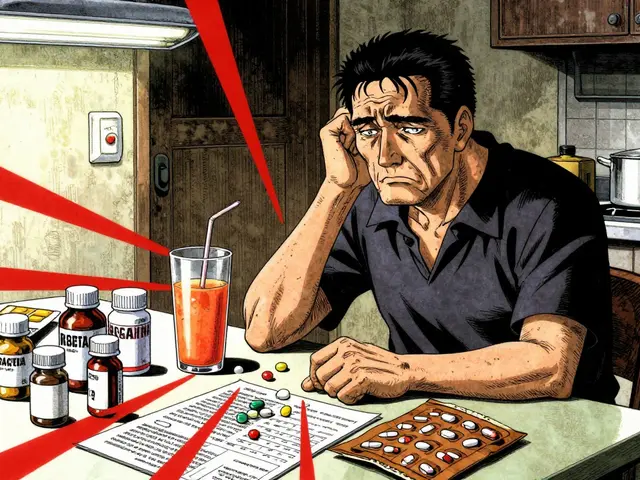
Here’s the catch: what helps one symptom can make the other worse. Take loperamide (Imodium). It slows your gut down-great for diarrhea, terrible if you’re already constipated. On the flip side, magnesium citrate or polyethylene glycol (Miralax) pulls water into your bowels-perfect for hard stools, but a disaster if you’re already having loose ones. That’s why most people with IBS-M end up keeping two meds on hand: one for constipation, one for diarrhea.
Studies show that single-target drugs like linaclotide (for constipation) or eluxadoline (for diarrhea) only work for about 20% of IBS-M patients. That’s why doctors often turn to broader options. Antispasmodics like dicyclomine (Bentyl) relax gut muscles and can reduce pain and cramping regardless of whether you’re constipated or not. About 40-50% of people get relief with these. Even better, antidepressants-yes, antidepressants-have proven effective. Low-dose tricyclics like amitriptyline (10-25mg at night) don’t treat depression here; they calm the nerves in your gut. Studies show a 55-60% response rate for pain and overall symptom improvement in IBS-M, higher than in other subtypes.
Diet: The Low FODMAP Diet Works-But It’s Not Easy
Food is the biggest trigger for most people with IBS-M. A 2021 study in Gastroenterology found that 50-60% of IBS-M patients saw improvement on the low FODMAP diet. That’s less than the 70-75% seen in IBS-D, but still significant. FODMAPs are short-chain carbs that ferment in the gut and pull water in, causing bloating, gas, and unpredictable bowel movements. High-FODMAP foods include onions, garlic, wheat, dairy (lactose), apples, and artificial sweeteners like sorbitol.
The diet isn’t about cutting everything forever. It’s a three-step process: eliminate high-FODMAP foods for 2-6 weeks, then slowly reintroduce them one at a time to find your personal triggers. Many people think they’re sensitive to dairy, but it’s often lactose-not fat or protein-that’s the problem. Same with gluten: it’s not gluten itself, but the fructans in wheat that trigger symptoms. That’s why working with a registered dietitian who knows IBS is critical. You don’t want to eliminate healthy foods unnecessarily.
Real-world feedback from Reddit and IBS forums confirms this: 62% of IBS-M users say low FODMAP helped the most. One user, u/SarahIBS2022, reduced her symptom days from 25 to 8 per month after combining the diet with peppermint oil capsules. But 52% also report ‘diet fatigue’ after six months. That’s normal. The key is flexibility. You don’t need to be perfect. Some days you’ll eat a high-FODMAP meal and feel fine. Other days, even a small amount of onion ruins your week. Track it. Learn your patterns.

Stress, Anxiety, and Your Gut: The Mind-Gut Connection
Stress doesn’t cause IBS-M, but it turns up the volume on your symptoms. A 2019 study found 68% of IBS-M patients report worse symptoms during stressful times. That’s because your gut and brain are wired together through the vagus nerve. When you’re anxious, your gut reacts-faster, slower, tighter, looser. That’s why cognitive behavioral therapy (CBT) is now strongly recommended by the American Gastroenterological Association. CBT doesn’t mean you’re ‘crazy.’ It means you’re learning to break the cycle: stress → gut spasm → fear → more stress.
Studies show CBT reduces symptom severity by 40-50% compared to just reading about IBS. Apps like Cara Care or The IBS Network offer guided CBT programs you can do at home. Even simple breathing exercises, 5 minutes twice a day, can lower your overall gut sensitivity. Meditation, yoga, and regular walks aren’t ‘nice-to-haves’-they’re part of your treatment plan.
Practical Tools: Tracking, Timing, and Trial
You can’t manage what you don’t measure. Start with a symptom diary. Track:
- Stool type (use the Bristol Stool Scale: 1 is hard nuts, 7 is watery)
- Pain level (0-10)
- Food eaten
- Stress level
- Medications taken
Use an app like Cara Care or even a simple notes app on your phone. People who track digitally improve 35% more than those using paper. After 4 weeks, you’ll start seeing patterns. Maybe you always get diarrhea after coffee on weekends. Or constipation hits every time you skip lunch. That’s your data.
Keep two meds ready: one for constipation (like polyethylene glycol 17g daily), one for diarrhea (loperamide 2-4mg as needed). Don’t take them daily. Take them only when needed. Most people find they need to switch between them every few days. It’s messy, but it works. Avoid over-the-counter ‘IBS remedies’ that promise to fix everything-they rarely do.

What’s New and What’s Coming
The IBS treatment landscape is changing. In 2023, the FDA approved ibodutant, a new drug targeting nerve signals in the gut. In phase 3 trials, it improved global symptoms in 45% of IBS-M patients-nearly double the placebo rate. That’s promising. Also, microbiome testing like Viome’s Gut Intelligence test uses AI to analyze your gut bacteria and recommend personalized diets. Early results show 58% symptom improvement in pilot studies.
But here’s the reality: no cure is coming soon. IBS-M is complex. It’s nerves, bacteria, diet, stress, and genetics all tangled together. The goal isn’t to eliminate symptoms completely-it’s to reduce them enough that you can live without fear. Most people who stick with a combination of diet, stress management, and smart medication use see big improvements within 3 to 6 months. It’s not instant. But it’s possible.
What Doesn’t Work (And Why)
Don’t waste time on:
- Extreme diets (no carbs, no fat, no sugar)-they’re unsustainable and often make things worse
- Overusing laxatives or anti-diarrheals-your gut gets dependent, and symptoms rebound
- Blaming yourself-this isn’t your fault. It’s not ‘stress’ or ‘eating too fast’
- Waiting for a miracle pill-there isn’t one yet, and chasing it delays real progress
The most successful people aren’t the ones who find the perfect diet. They’re the ones who learn their body’s rhythm. They know when to eat gently, when to take their med, when to breathe, and when to let it go.
Can IBS-Mixed turn into Crohn’s disease or ulcerative colitis?
No. IBS-Mixed is a functional disorder, not an inflammatory one. It doesn’t cause damage to the intestinal lining or increase cancer risk. While symptoms can feel similar to Crohn’s or colitis, IBS-M doesn’t progress into those conditions. However, if you develop new symptoms like weight loss, bloody stools, or fever, you should see a doctor immediately to rule out other diseases.
Is the low FODMAP diet the only diet that works for IBS-Mixed?
No, but it’s the most studied and effective. Other approaches like a gluten-free diet (for those with non-celiac gluten sensitivity) or a high-fiber diet (for constipation-predominant phases) can help, but they don’t address the full range of triggers like FODMAPs do. Many people find success combining low FODMAP with smaller, regular meals and avoiding trigger foods like caffeine and fatty foods.
Why do some medications help one person but not another?
Everyone’s gut microbiome, nervous system, and food triggers are different. What works for one person might worsen symptoms for another. For example, peppermint oil helps 68% of users reduce pain, but 22% get heartburn. Antidepressants work well for many, but not everyone tolerates them. That’s why personalized tracking and trial are essential. There’s no one-size-fits-all in IBS-M.
How long does it take to see results from managing IBS-Mixed?
Most people start noticing improvement in 4 to 8 weeks with consistent diet and stress management. Medications like low-dose antidepressants may take 6 to 12 weeks to show full effect. Full stabilization-where symptoms are predictable and manageable-often takes 3 to 6 months. Patience and consistency matter more than speed.
Should I avoid all dairy if I have IBS-Mixed?
Not necessarily. It’s lactose, not dairy fat or protein, that causes problems. Many people with IBS-M can tolerate hard cheeses, yogurt with live cultures, or lactose-free milk. Try eliminating lactose for 2 weeks, then reintroduce small amounts to see how you react. You might be surprised-some people find they can handle butter or cream fine.
If you’re feeling overwhelmed, start small. Pick one thing: track your symptoms for a week, cut out one trigger food (like onions or coffee), or try 5 minutes of breathing each morning. Progress isn’t linear. Some days will be better than others. But with the right tools, you can take back control-without waiting for a cure.


Wendy Lamb
4 Feb 2026 at 16:56Just started tracking my stools with the Bristol Scale after reading this. Week 1: 3 days diarrhea, 4 days constipation. No coffee, no onions. Still a mess, but at least I know it’s not just me.