




When a generic drug hits the market, regulators need to be sure it works just like the brand-name version. But what if the patients taking the drug aren’t healthy volunteers in a clinical trial? What if they’re elderly, have kidney disease, or are on five other medications? Traditional bioequivalence studies-where 24 healthy adults take two versions of a drug and give blood samples every 30 minutes for 48 hours-don’t capture that reality. That’s where population pharmacokinetics comes in. It’s not about averages. It’s about understanding how every patient’s body handles the drug, and whether two formulations deliver the same exposure across real, messy, diverse populations.
What Population Pharmacokinetics Actually Does
Population pharmacokinetics, or PopPK, isn’t a new idea. It started in the late 1970s, but it’s only in the last decade that regulators like the FDA and EMA began to fully embrace it. Instead of studying a small group of healthy people under perfect conditions, PopPK uses sparse, real-world data. Think of it this way: you’re not asking 50 people to come in for 10 blood draws. You’re using the 2 or 3 blood samples already taken from 100 patients during routine check-ups, ER visits, or hospital stays. Each sample is a piece of a puzzle. Put them all together, and you get a picture of how the drug behaves across an entire population. The magic happens in the math. PopPK uses nonlinear mixed-effects modeling to separate two types of variability: what’s predictable (because of age, weight, kidney function) and what’s random (why one person clears the drug faster than another, even when all else is equal). This lets you answer questions like: Does the generic version of my blood thinner expose elderly patients to the same drug levels as the brand? Or: Do kids with cystic fibrosis absorb this antibiotic the same way as adults?Why It’s Better Than Traditional Bioequivalence for Complex Cases
Traditional bioequivalence relies on geometric mean ratios of AUC and Cmax. If those fall between 80% and 125%, the drugs are considered equivalent. Simple. But it’s also blind. It doesn’t tell you if the generic works the same in patients with liver failure, or if the drug’s variability spikes in people over 75. PopPK doesn’t just say “yes” or “no.” It shows you where and why differences might matter. Take a drug with a narrow therapeutic index-like warfarin or digoxin. A 10% difference in exposure might mean the difference between a clot and a bleed. Traditional studies might pass the generic because the average exposure is within range. But PopPK can reveal that in patients with low creatinine clearance, the generic leads to 20% higher concentrations. That’s not just noise-it’s a clinical risk. The FDA’s 2022 guidance explicitly says PopPK is ideal when “the target population is quite heterogeneous and the target concentration window is relatively narrow.” PopPK also saves time and money. A traditional crossover bioequivalence study for a drug used in children or the elderly can take years and cost millions. PopPK can use data already collected in Phase 1 or Phase 3 trials. Merck and Pfizer have reported cutting additional clinical trials by 25-40% when PopPK successfully proved equivalence across subgroups. That’s not just efficiency-it’s ethics. You don’t have to dose frail patients multiple times just to meet a regulatory box.The Tools and the Talent Behind the Scenes
You can’t run PopPK in Excel. It needs specialized software. NONMEM has been the industry standard since the 1980s. Monolix and Phoenix NLME are also common. These tools handle the heavy math: estimating population means, individual deviations, and how covariates like body weight or creatinine clearance affect drug clearance. But software alone isn’t enough. You need people who understand both the pharmacology and the statistics. Training a pharmacometrician-the specialist who runs these models-takes 18 to 24 months. They need to know how to build a model, validate it, avoid overfitting, and explain it to regulators. And that’s where many companies stumble. A 2022 survey by the International Society of Pharmacometrics found that 65% of professionals listed “model validation and qualification” as their biggest challenge. There’s no universal checklist. One regulator might accept a certain type of bootstrap validation. Another might demand a separate external dataset. That inconsistency is a real barrier.
Regulatory Acceptance: FDA vs. EMA vs. Others
The FDA has led the charge. Their 2022 guidance didn’t just encourage PopPK-it gave clear expectations: at least 40 participants, careful covariate selection, transparent model-building steps, and validation reports. Since then, about 70% of new drug applications from 2017 to 2021 included PopPK analyses. The EMA has been more cautious. Their 2014 guideline supports PopPK for understanding variability, but still often requires traditional bioequivalence studies for approval. Japan’s PMDA adopted similar standards to the FDA in 2020. But in some regions, regulators still don’t trust PopPK alone to prove equivalence. A senior pharmacometrician from a major generics company shared on Reddit in March 2023: “PopPK has been invaluable for demonstrating bioequivalence in renal impairment populations where traditional studies would require unethical dosing.” But they also added: “Regulatory acceptance varies by region-FDA is more receptive than some EMA committees.” That’s not a flaw in the science. It’s a flaw in the system. Until global harmonization catches up, companies must tailor their submissions region by region.Where PopPK Falls Short
PopPK isn’t a silver bullet. It struggles with drugs that have extremely high variability-like some antiepileptics or blood thinners where within-subject variability is over 40%. In those cases, replicate crossover designs still give more precise estimates. PopPK also needs good data. If your Phase 1 trial only collected blood samples at 1, 4, and 8 hours, you might not have enough information to model clearance accurately. You can’t fix bad data with better math. Overparameterization is another trap. Adding too many covariates-age, weight, sex, gene variants, diet, time of day-can make a model fit the noise, not the signal. A 2019 analysis of FDA Complete Response Letters found that 30% of PopPK submissions were rejected or asked for more info because the models were too complex or poorly validated. And then there’s the human factor. If your clinical team doesn’t plan for PopPK from the start, you’ll end up with incomplete sampling schedules or missing covariate data. The FDA recommends starting PopPK planning in Phase 1-not Phase 3. That means pharmacometricians need to be in the room when the trial design is being written.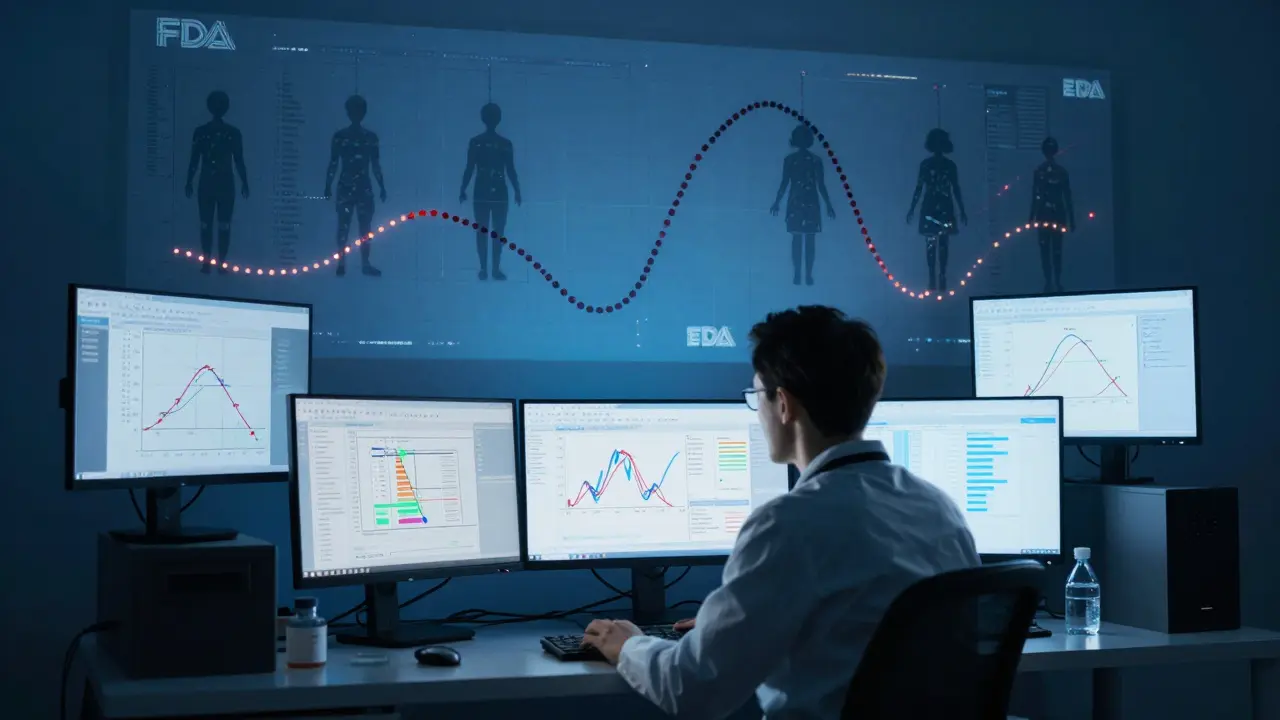
What’s Next for PopPK
The future is accelerating. Machine learning is now being used to detect nonlinear relationships that traditional models miss. A January 2025 paper in Nature showed how neural networks could predict drug exposure based on patient history, lab values, and even EHR data-not just the usual covariates. That’s a game-changer for complex drugs and polypharmacy. The IQ Consortium is working on standardizing model validation by late 2025. That’s huge. If everyone agrees on what “good validation” looks like, regulators will trust PopPK more. And the market is responding. The global pharmacometrics market is expected to hit $1.27 billion by 2029. Nearly all top 25 pharma companies now have dedicated PopPK teams. Biosimilars? They’re almost entirely dependent on PopPK because traditional methods don’t work for large molecules.How to Know If PopPK Is Right for Your Drug
Ask yourself these questions:- Is the target population diverse? (Elderly, children, organ impairment, multiple comorbidities)
- Is the therapeutic window narrow? (Small changes in exposure = big clinical risk)
- Are traditional bioequivalence studies unethical or impractical?
- Do you have access to real-world PK data from routine monitoring?
Final Thought: It’s Not About Replacing Traditional Studies
PopPK doesn’t replace traditional bioequivalence. It complements it. Think of traditional studies as a high-resolution photo of one person. PopPK is a mosaic made of thousands of blurry snapshots-each imperfect, but together, they show the whole landscape. For regulators, that’s more valuable than a perfect image of a single subject. Because drugs aren’t taken by healthy volunteers. They’re taken by people. And proving equivalence means proving it for all of them.Can population pharmacokinetics replace traditional bioequivalence studies entirely?
Not always. Traditional studies still work best for drugs with wide therapeutic windows and in healthy populations. PopPK shines when the patient group is diverse, the drug has a narrow therapeutic index, or traditional studies are unethical (e.g., in children or patients with organ failure). Regulators often require both approaches for complex cases, but PopPK can reduce the need for extra trials.
What’s the minimum number of patients needed for a reliable PopPK analysis?
The FDA recommends at least 40 participants for robust parameter estimation. But the real number depends on the expected variability and the strength of the covariate effects. For drugs with strong weight-based clearance, you might need fewer. For drugs with complex, multi-factor interactions, you may need 80 or more. Quality of data matters more than quantity.
Why do some regulators accept PopPK and others don’t?
It comes down to experience and standardization. The FDA has been using PopPK for over a decade and has published detailed guidance. Other agencies, especially in Europe and Asia, are still catching up. Without universal validation standards, regulators hesitate to rely on models they can’t fully audit. The IQ Consortium is working on global standards by late 2025, which should help close this gap.
Is PopPK only used for generics?
No. PopPK is used for brand drugs too-especially when dosing needs to be adjusted for subgroups like elderly patients or those with kidney disease. It’s also critical for biosimilars, where traditional bioequivalence methods don’t work. Any time you need to prove consistent exposure across a diverse population, PopPK is the tool of choice.
Can machine learning replace traditional PopPK modeling?
Not yet. Machine learning can detect hidden patterns in large datasets and improve predictions, especially with complex covariates. But regulators still require transparent, interpretable models. Nonlinear mixed-effects models are still the gold standard because their assumptions are clear and testable. ML is becoming a supplement-not a replacement-for now.







Rachel Liew
1 Feb 2026 at 17:56Wow, this actually made me understand why my grandma's blood thinner dose was so finicky. I never realized it wasn't just about the pill, but how her body handled it differently than a healthy 25-year-old in a trial. Thanks for explaining it like I'm not a scientist.