




The core of the problem is that medical education on generics is often a footnote in a massive pharmacology curriculum. In many cases, doctors learn how a drug works to treat a disease, but they aren't taught how that drug is manufactured or validated as a generic. This leaves them vulnerable to "brand-name habits"-prescribing the name they recognize from a textbook rather than the chemical entity itself.
The Science of Bioequivalence: What Should Be Taught
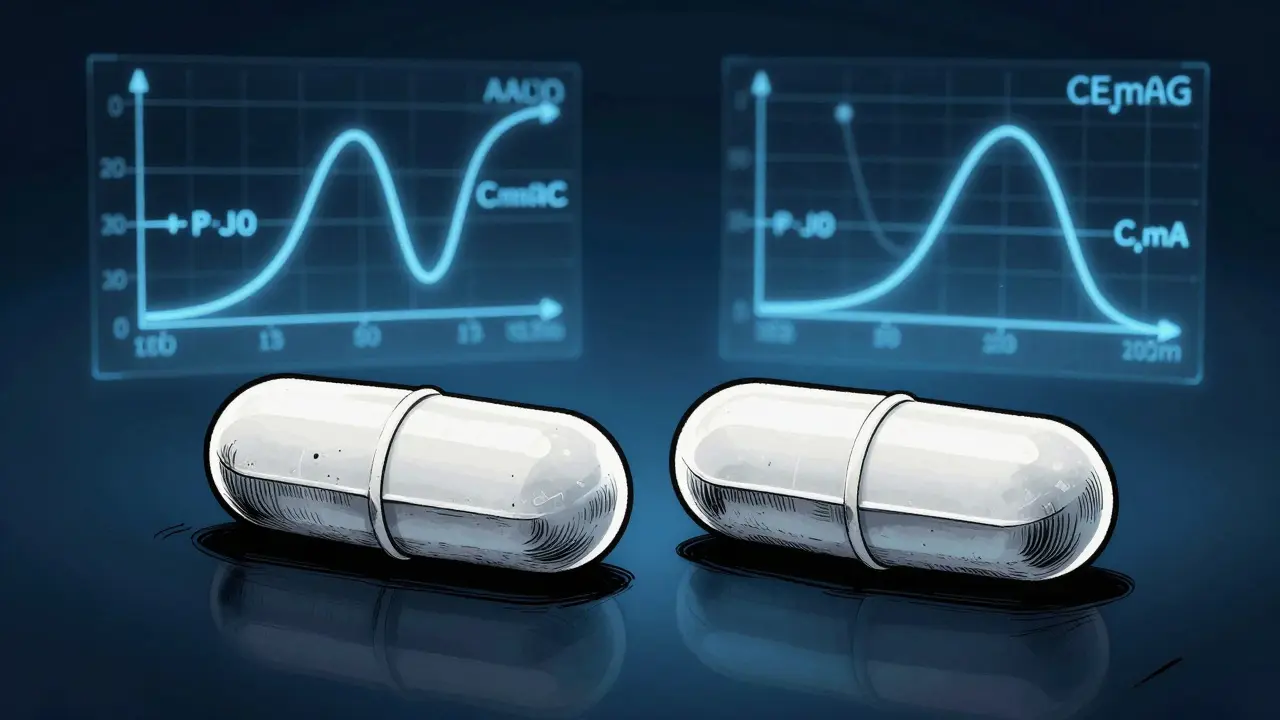
To understand if a doctor is properly educated, we have to look at the concept of Bioequivalence. In simple terms, a generic drug is bioequivalent if it delivers the same amount of active ingredient to the bloodstream at the same rate as the brand-name drug.
Regulators like the FDA and the EMA use a very specific mathematical window to prove this. For a generic to be approved, the 90% confidence intervals for the Area Under the Curve (AUC) and the maximum concentration (Cmax) must fall between 80% and 125% of the reference drug. When a doctor doesn't know these numbers, they may perceive a "slight difference" as a failure of the drug, rather than a standard, acceptable regulatory variance.
| Attribute | Standard Requirement | Purpose |
|---|---|---|
| Cmax (Max Concentration) | 80-125% of Brand | Ensures the drug hits the target peak strength. |
| AUC (Total Exposure) | 80-125% of Brand | Ensures the body absorbs the same total amount. |
| Study Sample Size | 24-36 Healthy Volunteers | Provides a statistically significant pharmacokinetic profile. |
| Active Ingredient | Identical (INN) | Guarantees the therapeutic mechanism is the same. |
The "Knowledge-Behavior Gap" in the Clinic
Here is where it gets interesting: knowing the science doesn't always change the prescription pad. A study from Malaysia involving 30 doctors showed that while a short, interactive lecture could boost knowledge scores by over 25%, it did almost nothing to change how they actually prescribed drugs. Why? Because medicine is a social profession. Junior doctors often mimic the prescribing style of their seniors. If a mentor always writes "Lipitor" instead of "Atorvastatin," the student does the same, regardless of what they learned in a 45-minute seminar.
This is compounded by the sheer speed of modern medicine. Many doctors report having only 12 to 18 seconds to make a prescription decision. In that window, the brain reaches for the most familiar label. This is why INN Prescribing (using the International Nonproprietary Name) is so critical. When a doctor prescribes the chemical name rather than the brand, they remove the bias and allow the pharmacist to select the most cost-effective, bioequivalent option.

Specialty Concerns: When Equivalence is Questioned
Not all drug classes are viewed equally. While most physicians agree that generics are generally equivalent, there is significant anxiety around Narrow Therapeutic Index (NTI) drugs. These are medications where a tiny change in dose or absorption can lead to toxicity or treatment failure.
For example, a significant number of neurologists are hesitant to switch epilepsy patients to generic antiepileptics. They worry that even a 10% swing in absorption could trigger a seizure. Similarly, doctors often express concern over generics of warfarin or levothyroxine. These fears are often rooted in real-world anecdotes-like the 2016 situation with generic Concerta, where some providers reported reduced efficacy despite the drug meeting bioequivalence standards. When a doctor sees a patient fail on a generic, that single experience often outweighs years of regulatory data.
How to Actually Fix Medical Education
If traditional lectures aren't working, how do we bridge the gap? The evidence suggests we need to move away from passive learning. The "teach-back" method-where the provider asks the patient to explain the difference between a brand and generic in their own words-has been shown to reduce patient confusion by over 60%. This forces the doctor to simplify the science, which in turn reinforces their own understanding.
Beyond communication, we need structural changes in how doctors are trained:
- Mandatory INN use: Institutions like the Karolinska Institute have seen a 47% increase in generic prescribing by requiring students to use chemical names in their evaluations.
- Experiential Learning: Training needs to mimic the pharmacist's path, involving the review of hundreds of real-world prescriptions with direct feedback.
- Digital Decision Support: Integrating bioequivalence data directly into Electronic Health Records (EHR) so doctors can see the equivalence data at the point of care.
The Economic Stakes of Better Training
This isn't just an academic exercise; it's a financial necessity. Generic drugs make up about 90% of prescriptions in the U.S. but only 22% of the spending. By improving how doctors understand and communicate equivalence, the healthcare system could potentially save billions. However, the industry is moving toward "complex generics"-like inhalers and topicals-which require even more sophisticated evidence of equivalence. If doctors struggle with simple tablets, the transition to complex generics will be even more challenging without a complete overhaul of pharmacology education.
Do all generic drugs have the same inactive ingredients as brands?
No. Generic drugs must have the same active ingredient, but they often use different fillers, binders, or dyes (inactive ingredients). While these don't change the drug's primary effect, they can occasionally cause different allergic reactions or affect how the tablet dissolves in some patients.
Why do some doctors refuse to prescribe generics for certain conditions?
This usually happens with Narrow Therapeutic Index (NTI) drugs, such as those used for epilepsy or thyroid disorders. Because these drugs require precise dosing, some doctors fear that the allowable 80-125% bioequivalence range is too wide and could lead to instability in the patient's condition.
What is INN prescribing and why does it matter?
INN stands for International Nonproprietary Name. It is the generic, chemical name of a drug (e.g., "Paracetamol" instead of "Tylenol"). Prescribing by INN prevents brand-name bias and ensures the patient gets the most affordable bioequivalent version available.
Can a generic drug be better than a brand-name drug?
In terms of the active therapeutic effect, they are designed to be the same. However, a generic may be "better" for the patient's wallet or may have a different inactive ingredient that is better tolerated by a specific individual.
How long does it take for a doctor to master bioequivalence concepts?
Research suggests that roughly 10 to 15 hours of dedicated instruction, combined with feedback on 50 to 100 real-world prescribing decisions, is necessary to achieve a level of competency that translates into clinical practice.





Write a comment